Sunday, July 14, 2013

Lest we Forget

We were having a FaceBook discussion about tattoos, when someone's tattoo of numbers across her wrist led to the discussion of Nazis tattooing ID Numbers on their prisoners' arms.

I had to make sure everyone knew what we were talking about. "On the off chance that some readers may not know what L___, me, & others are talking about... Prisoners in Nazi Concentration Camps had identification numbers tattooed on their arms. Right or left, and inside or outside of the arm varied by the camp. As a kid, there were always two little old ladies sitting on the front row at synagogue. The one on the aisle had hers on the upper left forearm so you always saw her number on her arm on the arm rest of the pew. 

"Lest We Forget"

I followed up with this message a few minutes later.
 I had tears in my eyes when I typed "Lest We Forget". (And I do again). Those that don't remember the past are doomed to repeat it. 

I've seen Bergen-Belsen where they burned down the dormitories for fear of disease and all that's left are mass graves marked with the number of dead in that grave.

I've seen Dachau and the Gate of the Great Lie - Arbeit Machts Frei. There they've restored some dormitories so you can see the conditions and you can see the "showers" that showered only poison gas and crematoriums conveniently located near by.


I walked up stairs hidden behind a built in bookshelf and into the world of a little girl. Her father published her diary after the war and it has sold an estimated 30 million copies.

Anne Frank died in Beregen-Belsen of Typhus. If she had survived, she'd be 84 right now and she was a teenager during the war. Soon they'll be no one left to tell the story and that is why I MUST tell the story whenever I can.

Today's entry from the Diary - 15 July 1944: "I see the world being slowly transformed into a wilderness, I hear the approaching thunder that, one day, will destroy us too, I feel the suffering of millions. And yet, when I look up at the sky, I somehow feel that everything will change for the better, that this cruelty, too, shall end, that peace and tranquility will return once more."

Thursday, July 4, 2013

LibraryBox for Disasters (aka a Medical eBook GO Bag)

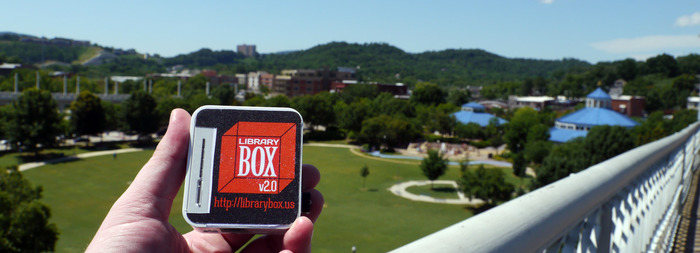
Recently, I was brainstorming about uses for my LibraryBox. If you aren’t familiar, LibraryBox is a concept started by Jason Griffey of the University of Tennessee at Chattanooga. The LibraryBox is a portable file sharing server built on a router the size of two packs of cards. The device is powered via USB cable and can be run off of a laptop, tablet, car charger, rechargeable battery pack like you’d have for your cell phone, even a solar charger is a possibility. The files are stored on a flash drive and the LibraryBox shares them out thru an internal wifi to devices via the device’s browser. Apple, Android, Windows, Phone, Tablet, Laptop; it is entirely platform independent.


I've heard Jason present on the LibraryBox and read some posts on it, but I didn't have a use envisioned. At Computers in Libraries 2013, I discovered another use as Jason had his LibraryBox on and loaded his presentation PowerPoint on it. That meant we could all download the slides to our tablets beforehand and follow along with a screen in our hands. Imagine not having to sit on the front row just to see the slides anymore.

Being a geek, I ordered the TP-Link MR3020 router and a 16 GB Flash Drive from Amazon (http://www.amazon.com/TP-LINK-Portable-802-11n-Wireless-TL-MR3020/dp/B006DEBXD0/?tag=jasongriffey-20 ) and built my own LibraryBox. But I still didn't have a practical use envisioned. I thought I might load all of my family pictures on a flash drive and share them at the next family gathering (Birthday party, Easter, Thanksgiving, Christmas, etc.).

In all the Social Media traffic from the ALA Annual Conference, I discovered Jason had started a Kickstarter project to bring LibraryBox to version 2.0.


Passing the Kickstarter information on to the ALA Think Tank group on Facebook (https://www.facebook.com/groups/ALAthinkTANK/ ) got me started brainstorming on other uses for the LibraryBox. If I say so myself, and I do, I think I found a great use.

When I was in the Air Force, we were usually subject to “recall” for deployment to any hot spot on the planet. For rapid movement, we all kept a GO Bag in our closet. Three sets of BDUs, 5 T-shirts, 5 briefs, 10 pairs of socks, 30 days of toiletries, a spare pair of glasses, etcetera; all of the things you’d need in the middle of nowhere without a Wal*mart around the corner. The contents would change depending on the season and area of interest covered by the Air Force Base I was stationed at. I obviously didn't need to carry a sweater to Saudi Arabia, but I would need it (and more) if we had to deploy to a mountainous area in winter. As an avid reader I always kept a stack of paperbacks to be read and I’d throw a pile in the top of my GO Bag.

That got me thinking that one place people need books is when they've rapid deployed to a disaster area. Especially true of medical personnel who may be forced to perform procedures they wouldn’t usually perform at home. Think about the doctors responding to the Haiti earthquake a few years ago. No electricity, phone, internet, running water; the whole infrastructure of modern life unusable. I’m sure they’d all love to have a set of basic references they can use to refresh their memory of unusual procedures. Everybody is going to do great with the basics, but the day after the event or two days after, when they want to give the patient the best recovery. When they have the time to do fine, detail work, they may need to look at some reference works. Also they may respond to a radiation event or another type of event that no one has any practice with.

The National Library of Medicine (NLM) has a division known as Specialized Information Services (SIS). They maintain a lot of resources for disaster recovery. One of those is a gateway (http://disasterlit.nlm.nih.gov/) to freely available online resources related to disaster medicine and public health. Resources include expert guidelines, factsheets, websites, research reports, articles, and other tools aimed at the public health community. Gateway, for those unfamiliar with this usage, means the resources are all linked from this one central database. You may have heard portal or federated search as other terms for this type of database.

All of the resources are downloadable files free of any copyright restrictions.
Examples of the items you can link to from the DisasterLit database include:
  • FEMA’s Radiological Emergency Preparedness: Program Manual
  • International Red Cross’ War Surgery: Working with Limited Resources in Armed Conflict and Other Situations of Violence
  • International Red Cross’ Caring for Volunteers: A Psychosocial Support Toolkit
  • International Atomic Energy Agency’s Communication with the Public in a Nuclear or Radiological Emergency
  • American Veterinary Medical Association’s Emergency Preparedness and Response (Bet you didn’t even think about animal care, but those animals may be the only food source for some while after the disaster.)


Ideally, you’d individually check the gateway and download whatever resources you’d expect to need to your tablet or phone, but what if you didn't  Or what if you don’t want to fill your device with all of these files when you may only need half of the works available? Wouldn't it be great if someone was detailed to download all of the SIS Gateway works to a flash drive? Then when you get to the Disaster Area, you can download the work you want to your device for use. What about another flash drive with a bunch of conversational language guides? You could have different Flash Drive for Flood, or Earthquake, or Volcano, or Forest Fire, or Tsunami, or whatever disaster.
 That’s my thought, a digital library of disaster resources that fit into your bag easier than a single paperback. Do you work with a team of medical personnel that might respond to an emergency? Then I could use your help.
Who should manage a program like this? Is there a resource you wouldn't want to be without? 

I’m hoping to present my idea to the NLM SIS folks, but any and all suggestions of other agencies to contact are welcome.

Thursday, May 30, 2013

Talking about Diversity

I started typing a long reply in a FaceBook group then realized it would be better placed here.

There are some topics in Librarianship that cycle around and back again. Sometimes they're initiated by a blog post someone read. Here's the article that started this discussion -- http://www.cbcdiversity.com/2013/05/searching-for-our-jeremy-lin.html#more

I've seen three different discussions today about Diversity in Librarianship. Whenever I hear someone ask "How do we get more diversity in Libraries?", my immediate thought is "Do we need more diversity in libraries?" The question assumes that as a fact to begin with, but it doesn't address it.

Maybe we need to define diversity before we start having this discussion. When you say diversity to someone of my years, I immediately go to school busing and the act of forcing children to attend a school further from their home just to even out the number of minorities in every school. That failed miserably. People want to attend schools in their neighborhood with their neighbors.
(I call it school busing, but the Wikipedia article calls it desegregation busing - http://en.wikipedia.org/wiki/Desegregation_busing )

I don't think we need that type of diversity in libraries or anywhere. I think society diversifies in its own way and in its own time.

I grew up in SE PA in a blue collar neighborhood in a blue collar city. I'm White, but grew up with a Black neighbor and Puerto Rican kid across the street that walked to school with me. I'm not "color-blind". I recognize friends and neighbors that are different races. I honestly don't care. I wasn't brought up to dwell on those differences. I played with all of those kids. The was a kid with Down's Syndrome around the corner. He had limitations, but he'd play some games, some times. Why not?

I still remember an event in High School that was identified by the local newspaper as a "Race Riot". In reality, it was a drug deal gone bad. It just happened the buyer was black and the dealer was white. When the fight broke out, it was all black guys on one side against all white guys on the other. But race had nothing to do with it.

At the end of senior year, there was an award assembly. There was actually a scholarship for the best academically performing Black. The kid that everyone expected to win stood up and some one else's name was read. We all wondered WTF? Matt is as White as they come. No he wasn't. He was interracial and we didn't know the kinky brown hair, tall height, and full lips were from his Black mother. He didn't scale as Black to us.

I had Black roommates in college, but I didn't socialize with them too much. I did socialize with a co-worker that lived a few doors down. He was Black, I'm not. Do you think folks were looking at me driving him to work and wondering what was going on? I doubt it even registered. That was the area we lived in.

 I joined the Navy Reserve while in college and was surprised there were no minorities in my unit. After graduation, I entered active duty in the Air Force. My first duty station was Ft. Hood TX. The Army doesn't have weather forecasters, the Air Force does that at all Army bases with aviation assets. I noticed that the Army was primarily Black and Hispanic and the Air Force was mostly White. But we did have one Black & two Hispanic in a 20 person unit. I think I was seeing self-selection in progress. Army soldiers were mostly urban kids, while Air Force attracted the farmers and rural kids. No one is telling people what service to join. They join because of their family and/or friends. The coastal kids join the Navy. The crazy ones join the Marines.

I still remember the mandatory Sensitivity Training session I had at my first Air Force station. They passed around index cards and we all had to say the first thing that came to mind when we flipped over the cards. My card said "Nigger Lover." My response: How old are these cards?
Trainer: That is a current set. What makes you think that is old?
Me: No one says that anymore??? That's from the 60's.
Trainer: Anyone have a different view?
Some Other Guy: Sure. If you were hanging out on a Saturday night in my hometown you might hear that if a mixed couple showed up.
Me: What??? Who would even notice? Why would you care unless you were jealous that she was with him?
Trainer: Next...

This was >25 years ago, but I remember something else from that session. Someone said something about Indians going off the Reservation. The Trainer noticed a bunch of puzzled looks so he asked for some views from the rest of the room. Plenty of us were WTF??? Wasn't Indians and reservations something out of the 1880's? Those of us East of the Mississippi had no idea there were still reservations out West.

(I was later stationed in Oklahoma City, so I know that Native Americans are a visible minority in the Western US. They are totally invisible in the East.)

My history tells me society is diversified. With my house at the 6 o'clock position on the dial, 12 is Hispanic, 2 is Hispanic, 4 is a rental & I haven't seen the new tenants yet, 8 is Black, & 10 is White.

With all of that history, 50+ years of one man's life, I don't see a problem so I'm not concerned about finding a solution. So I've come full-circle, Why do we need to do anything to Diversify? Isn't society doing that on their own?


Tuesday, May 21, 2013

Our Oklahoma City Home

Friends have asked about our Oklahoma City Home. The A marker is the house we rented while stationed at Tinker. The Red S is the Plaza Towers Elementary School.

Even more amazing to me. At this zoom, the path of the 1999 F5 Tornado shows as a tan line. The houses have been rebuilt, but the earth was so churned up that it still shows. I've circled the area in red to help you out, but the map is otherwise unmodified from Google Maps.


Friday, May 10, 2013

My Friends in their little electronic boxes


Friends,

I mean that salutation literally. You, dear readers, are the only friends I have and that concerns me.

Let me start the story in the beginning. Like most folks my age, I grew up playing outside with the neighborhood kids. Everyone within a block and within 2 years +/- my age were my friends. This continued thru my school years with only the range increasing to larger than a block and/or to being centered on specific places. I had school friends that I didn't see in the summer; Synagogue friends that I only saw on the weekend; Pool friends from the summer; etcetera.

ERSA Swim Team 1976 
(J is on back row, 1st male from the left.)

I went to college 3 hours from home and didn't go home very often, so the process started over in College. Still it followed the same pattern, friends were in the same class(es), or lived close, or worked with me, or were friends of other friends.

The same pattern reestablished itself when I was married and in the Air Force. Because life was a little more temporary, i.e. we moved more often, there might not have been as many friends as I’d had at some times in my life, but I always had someone I could invite to a Surprise Birthday party for my wife, or a backyard barbecue or to watch the big game, or whatever event called for a gathering.

Time stands still for no man. I eventually ended up stationed in Oklahoma City and divorced from my first wife. I made friends with people in the unit and I frequented a Bar / Dance Club that featured Country Dance Lessons two nights a week. The lessons were taught by a Country Dance Club and they’d match up singles or get club members to fill-in. I met the club members and dated some of the single ladies I met thru the lessons until I met my current wife. We became active members of the Club and had backyard barbecues, bridal showers, weddings, and weekends away at dance competitions. All of those activities I’d already associated with being friends. I had lots of friends and our wedding ceremony featured a fairly even grouping of co-workers, family, and dance club friends.


Soon after the wedding we transferred to Ramstein Germany and the process started all over again. We didn't join any organizations, but we had neighbor friends and coworker friends. Everything seemed normal to me.

Then came the cascade of events that ended in my separating from the Air Force. Those details may be discussed later, but for this post I’ll just say it was a rough time in my life. I returned to the states to Florida because that was where my parents lived and I had a FL Driver’s License in my pocket. (Military members can pick and choose what state they like to call home. FL has no personal income tax, so it is very popular.)

The plan was to settle in Tampa and go back to school for my Master’s degree. I had 2 year’s rights to the commissary & medical care, so I had both a nearby base and a University to attend. The same pattern “how to make friends and influence people”* reasserted itself. We became friends with neighbors and coworkers and classmates. Still it was a bit strained. I was working 40 hours a week and attending classes for another 8? hours and had homework for another 8? hours. (? = Yes, I’m just guessing at this time.) That meant I didn't have as much time for friends and we couldn't always plan on every weekend being free.

* - Would that be a better post Title?

While we were in Tampa the Apartment management had us all move out while they renovated the buildings, we moved and neighbors moved elsewhere so we had less geographic friends. Then graduation split up the classmates and all of a sudden we had more time but less people to spend it with. Like my classmates, I was looking for a job elsewhere, so I didn't really worry about it. I’d assumed it was a temporary condition.

I got that job elsewhere and we moved to Maryland. We had more family in the area, so that was an improvement, but we knew we’d be moving into a house when we found one so we didn’t make any friends around the apartment. Also my coworkers were spread out over a much larger area. We generally all lived within a 20 mile circle centered on Work, but we covered that circle from 7 o’clock on the dial around to 3 or 4 o’clock. In some cases it could take 1.5 hour to drive from my home to a coworker’s. We did buy a house, my first (at 41 years old), and that only decreased the number of potential friends by spacing out the living areas compared to the compactness of an apartment complex. 

So after 800 words, I get to the heart of the matter currently. I don’t have any friends that I can invite to a backyard barbecue or to watch the big game. I’m not involved in any organizations like the Elks, Moose, Rotary, etcetera. My wife’s health has deteriorated so we’re not going dancing. I don’t have the free time to leave the house to cultivate a friendship. I have a herd of cats to care for. I’m the only driver in the house, so I have to do all of the grocery shopping and other trips out of the house. I’m the cook and the maid. I’m not complaining. I said ‘til death do us part and I really mean it this time. I also said in sickness and in health. I will not leave the marriage this time. I take responsibility for that decision and I stand by it. If I left, Mrs. would have to live in an assisted living facility. She couldn't take care of herself.

So you, my friends, are the only friends I have. I only see little pictures of you on my tiny electronic screens. Are you real? I’ve met some of you in-person, face to face, so I know that some of you are real, but that accounts for less than 100 of you on Twitter. (I follow close to 2000. About 1200 follow me.) When it comes to FaceBook, the number I’ve met in person is higher because it includes friends from childhood, High School, College, and more distant family.

If we define a friend as someone that can feed your cats if a death in the family calls you out of town unexpectedly, or come to your rescue if your car runs out of gas, or bail you out if arrested, I’d be lucky if I had 5 people I could call on. (I know the last two are covered by roadside assistance & bail bondsmen, but the first is a real concern.)

I don’t like this situation, but I’m at a loss as to how to fix it. Is this normal in our society today? Are there millions out there just like me? Is this a stage in everyone's life or does it relate specifically to frequent moving and not setting roots? Is it right for me to join an organization that’ll take time away from managing my household? What about Mrs? Surely she feels lonely too. I’m the only person she sees most days. We do get out of the house for shopping together at least weekly. I’d probably go stir crazy if I was that limited. At least I get to interact with coworkers at the office.

This is the longest, the most personal, and the saddest post I've written. It should be in blood red; I've poured my life onto the page. Do you have any insight? Can you help me? Answer in Comments or via email to 7shore at gmail.

Thursday, May 2, 2013

How snarky is too snarky?

Friends,

This is my free space to say anything I want to; my online diary. It’s not about sharing secrets per se, but rather about discussing whatever is on my mind.

I’ve seen a number of discussions recently about the smarminess of online conversations with different ‘experts’ opining that anonymity makes it easier for the worst behavior to show up. I don’t really want to get into a discussion of all of the possible reasons for the level of *snarkiness / cynicism / rudeness / whatever term you prefer* to be on the rise.  I have my opinion, like everyone else, but I long ago learned that opinions are like assholes: everyone has one and they all smell about the same.

I’m more interested in raising the level of online civility and I’m not alone.  I’m participating in a Social Experiment – The No Library Whining Zone. For 24 hours, we pledge not to complain or whine about libraries publically. Details at http://librariankate7578.com/2013/05/01/the-no-library-whining-zone-a-social-experiment/

{Acknowledgements to Kate Kosturski, Andy Woodworth, Liz Burns, and Steve Thomas. If you haven’t heard their names, they are Librarian Rockstars, Movers & Shakers in the Library World, and Big in Lithuania (inside joke that 100 or so people will laugh at).}

I don’t need to expand on Kate’s blog, but I have thought it would be great to expand this experiment outside of the Library world to everyone online. I envision a NoWhineWednesday movement. In which we declare every Wednesday to be Whine Free on all Social Media sites. Will you join me?

Here are some inspirational pictures that hang on my cubicle walls.


Recognize that we are not all alike

Ensure expectations are clear

Seek to be inclusive

Project a positive outlook

Explore other’s viewpoints

Communicate for understanding

Treat others as they wish to be treated


Wishing everyone a peaceful day free of whining and complaints.

Namaste,

Jules

Wednesday, April 3, 2013

What's in a Name?

Some of you have known me for a long time, while others are just meeting me. Some of you connected with me via Twitter and others via FaceBook. If you've seen me on both Twitter & FaceBook, you know I list my name two different ways.This blog explains why.

My parents named me Julius at birth, but they called me Jules. Until 1990, everyone called me Jules. After 1990, I introduce myself as Jay but prefer to write it as J. 

Is there a little more back story? Sure. I had an Uncle Jay from Albany, GA, but his name was really Joseph William Strawder. As a true Southern Gentleman (yes, I'm being sarcastic), his buddies called him J W. 

"What happened in 1990?", you may ask. (Well? Ask it! I'm not going to pause here forever.)

In 1990 I returned to the US from 15 months stationed at Lajes Field, Azores. I was finally away from my first wife long enough to realize it wasn't going to work and decided to divorce. So I was starting my life over at a new base as a single. I really wanted to change everything about me and my nickname was one of those things I could change. 

I didn't know anything about branding in 1990. I thought I was making a clean break. Folks there is no such thing as a clean break in human society. I had no way to forecast the future existence of Social Media. I didn't know the mess I was going to create. 

On FaceBook I have friends from High School & Undergrad College that know me as Jules. I don't expect them to change, so I listed as Jules.

When I created my Twitter account, I listed as J. That's how "new" friends know me. Now I've found that I really like FB better as my Social Media Hub. Twitter is still great for instant chat and for use at conferences, but I there is more depth available on FB.

What's this all leading up to? If I meet you in person, I'm going to introduce myself as J. Only old friends call me Jules. Even my second wife, who I met in 1991, calls me J. If you know me from FB and call me Jules, I will respond. 1) It's not a common name. 2) I lived with it for 28 years, so I'm well trained to respond.
If we're in a conversation and people use both names, it's OK with me. I'm me whether you call me J. or Jules I'm still the same me.

Shakespeare had it right,
"What's in a name? That which we call a rose
By any other name would smell as sweet;
So Romeo would, were he not Romeo call'd,
Retain that dear perfection which he owes
Without that title. Romeo, doff thy name,
And for that name which is no part of thee
Take all myself." 
(Romeo & Juliet, Act II, Scene II.)