Saturday, June 17, 2017

Eulogy for my wife - Joyce Shore

Hi. Some of you know me as J. and others know me as Jules and that’s the beginning of our story.
In January 1990, I was assigned to a new base and I was divorcing my first wife. I needed a change, so I changed my nickname to J.
In January 1990, Joyce was already in Oklahoma City, having moved there with her first husband and she was divorcing too.
Sometime in late August of 1990, Joyce was granted a divorce.
Roughly two weeks later, I was granted a divorce too.
Some months later, Joyce and I were over the shock of all the change and we were tired of being alone. Of course, we hadn’t met yet, but we were looking.

The Oklahoma Country and Western Dance Association gave free dance lessons at a club off I-35 every Tuesday and Thursday; Two-step, Schottische, Waltz, and the occasional line dance. The club members would usually stay to dance after lessons. It drew people to the club on off nights.
One Thursday in June 1991, after lessons, as everyone was still hanging around, just as a new song started, I walked over to a table of club members; Ken and Janice James, well, Janice had a different last name then, but remember Ken and Janice because we will get back to them. Anyway, Ken and Janice, and Ursula and Johnny had just sat back down, so I said to a lady at the table, someone I’d never seen before, “Everyone else looks like they need a break, would you like to dance?”

And that, my friends, is the real beginning of this story. After a dance or two, Joyce invited me to join her Saturday afternoon at an event held by a different dance organization in town. I went, I danced, I won a door prize – a gift certificate at a restaurant- , and I asked Joyce if she’d like to go to dinner.

The next scene in the story has Joyce and me moving in together to a rental house with Shadow, a 20 year old grey female cat, and Timothy, an indoor/outdoor heavy weight tabby with one folded ear. You do realize you can’t tell a story about Joyce without a few cats?

Come late October, still 1991, there was a morning we opened the door to hear the howls of a cat across the street. “Hey, J. do you wanna climb a tree?” Turns out the kitten was under the church van parked across the street and not up a tree. He was, however covered in oil; I guess the van had a leak. And that was Beetlejuice.

I know when, because a week after that we took a road trip. A “Meet the parents” type event. We drove from Oklahoma City to Jacksonville to surprise my Sis for her birthday and Joyce got to meet my parents and my sister. Then we drove up to Culpeper and I got to meet Donna and Harold and the kids. On the way back to Oklahoma City, we stopped at Nashville to see the sights. We were in the audience for a taping of a Christmas special by the Statler Brothers and a Crook & Chase show.

We went to dance contests in Muskogee and Dallas, and I met Louise and Robby in Ada Oklahoma, and I met Bowman and Jane in Arkansas, and time passed. We got an invite to Ken and Janice’s wedding, you remember Ken and Janice, I told you we’d get back to them. Ken and Janice had a beautiful wedding with all the club members in attendance, and the day after, I rolled over in bed and said, “Let’s get married?” Not that dramatic as proposals go, nor was it romantic, but it worked. On 8-8-92, the family gathered and a wedding was had.

Then came orders for a 4 year tour at Ramstein Germany. We had a great time in Germany. We saw all the sights. Paris, Trier, Cologne, Heidelberg, wine fests on the Mosel, cruising on the Rhine, Amsterdam, Brussels, there was always something to do; someplace to see. And the cats came too, Pipsqueak, and Minke, she’s the kitten the little German boys found, and Gheist and Weizen born among the barn cats next door and cold and hungry and in our door they came. We rescued some of Gheist and Weizen’s siblings and the base vet would give them their shots and find a family for them.

Then my time in the Air Force came to an end and I wanted to go back to school for my Master’s degree. We had Florida driver’s licenses in our pockets, because my parents lived there and Floridians pay no state personal income tax. I needed a university and a base close together because I had rights to base services for 2 years, so we settled in Tampa. It was great living close to my folks. I hadn’t had holidays with my parents in years. And Joyce worked for a group of orthopedic surgeons and I went to school and worked full time and life was great.

Then came the first of many health scares. Joyce had a triple bypass. Recovery was complicated, but family took turns visiting for a week at a time to keep Joyce company while I worked and went to school. And Joyce got better and went back to work and that semester I graduated and then got a job with Tampa Public Library.

But I was looking for a government job, because my Air Force years count for retirement from the government. I was finally hired and we moved up here. Joyce was thrilled to be back home and visits to see Donna and Harold happened about every two months. Holidays were spent with the Virginia relatives and Denise had married and Ashby had married and along came grand nephews.
Joyce got a job in a Doctor’s office. They loved her. She could do the paperwork while chatting with the patients and generally being friendly. The exact person you want to be the face of your office.

We rescued more kittens. I said no more at 13 and we got to 32 before Joyce realized it was a lot of work and she couldn’t save them all.

But Joyce was a type 1 diabetic, so there were more health scares. In 2006 she had a stroke and the state said she had to stop driving. But she recovered, and transportation was worked out and she kept working for Dr. Sivieri. Her vision was worse. On average her corrected vision was 20/70 meaning she saw at 20 feet what the average person sees at 70. But she got magnifiers and computer software to magnify the screen and she could still work.

Then in 2011, she had a Fem-Pop bypass, to improve blood flow in her leg. And that surgery became infected and they had to re-do it and she was released to home with two different IV antibiotics, given 3 times a day for one and twice a day for the other and I learned to give IVs thru a picc line. The month passed and the antibiotic course ended and Joyce and I both went back to our offices.

And life went on, and we visited Culpeper and we went to birthday parties and Thanksgiving and Christmas and we took care of our cats and we worked our jobs until
dun dun dun duh…
The next health crisis.

In December 2012 Joyce got a cold and with it came vertigo. The cold ended, but the vertigo never did. We saw the ENT and he pointed us to the neurologist. We saw the neurologist and he pointed us to the ENT. We saw the experts at Johns Hopkins and the final answer was there’s nothing we can do about it. Diabetic neuropathy meant there was a lag time in the signal from one inner ear compared to the other. If Joyce moved slow and focused on a fixed point she could walk without falling down, but move too fast or bend over to pick something up and she’d at best feel like she was falling, at worse, she’d fall.

She couldn’t work anymore and retired on Social Security disability. Those were a very lean 6 months until Social Security started paying, so we didn’t go out much or do much. But, as all things in life, this too passed and we got back to normal except Joyce didn’t get out much or do much.

Then Joyce’s oldest sister, Donna passed and Culpeper changed and Thanksgiving and Christmas just weren’t the same.

Then along came the next High School Reunion and Joyce got on the committee and had a ball tracking down info on old classmates and putting together the reunion booklet with everyone’s info and coming to Culpeper for meetings. After the reunion it got even better as a group decided they didn’t want to lose touch. They decided on bimonthly lunches and Joyce became the one to send out reminder emails and we still got to Culpeper every two months and Joyce had something to do.

Then came a day in late September 2016 when Joyce’s chronic dizziness resulted in a fall at home. She said she landed on her butt, but she had a bruise the size of my hand on her right hip. She thought she was okay, but was walking kinda stiff. After two weeks she was still stiff so we started seeing doctors to figure out what was wrong. We started with an xray that didn’t tell us much because her right hip had been replaced in 2015 and metal doesn’t play well with xrays. Then we saw the hip doctor and her walking got worse and we saw the back doctor and surgery was decided on to occur Dec 29, 2016. We released from the hospital to a rehab center for two weeks of rehab, but the surgery was infected and Joyce went back to the hospital and got cleaned out and started on IV antibiotics and we went back to rehab for a four week stay. On February 15th Joyce was back home. There were wound dressing changes and Physical Therapy and she was still on IV antibiotics, but as you can tell from the rest of this story, those were all old hat by now and life went on and Joyce got healthier.
We almost made the March lunch for the class of 68, but Joyce thought a 2 hour car ride might be too much. She was uncomfortable after 30 minutes in a car; 2 hours? Nah. Next time she’d be better.

On Friday April 7th she went to PT and we went to lunch and everything was normal. Overnight between Saturday the 8th and Sunday the 9th, Joyce woke me up to help her get to the bathroom. She couldn’t roll over without pain. Three courses of pain meds overnight didn’t help, so we went to the ER and found Joyce had her second infection of this surgery. We thought it was all over and life was going back to normal.

And I’m going to wrap it up soon because it’s recent and raw and I don’t want to cry or make you cry. Infections are the leading cause of confusion in older people. So each of these infections would be accompanied by periods when Joyce didn’t know where she was or why she couldn’t go home.
But, the second infection led to a third infection and more confusion and unfortunately the confusion never cleared and she was diagnosed with Lewy Body Dementia. Fortunately Joyce had told us, in an advanced directive that she didn’t want to live that way, so we withheld all medical interventions and let her go. Her way.


And the story ends, and the second era of Joyce’s life ends and the second era of my life ends.

Hi. I’m Jules.    

Thursday, September 11, 2014

In Memoriam: 9/11/2001

On this thirteenth anniversary of the attacks, I thought I'd write up my memories of activities around me on that day. One thing I've learned in talking with people about 9/11 is the "localness" effect on what they remember. I work in the DC Metro region so memories around here relate to the Pentagon attack. Friends in North Jersey talk about the World Trade Centers.

I was in Tampa working for the Tampa-Hillsborough County Public Library System at their headquarters library in downtown Tampa. The President was reading to school children in Sarasota, FL. Sarasota is the south side of Tampa Bay, which is surrounded by Tampa to the East & North, and St. Petersburg to the West. The bay is split by a peninsula about 2 miles wide and 5 miles high.  The south end of that peninsula is MacDill Air Force Base. With the President in the area, Air Force One was parked at MacDill and I'm sure the Coasties got the rare opportunity to use the call sign Coast Guard One and flew the Prez across the bay in one of their rescue copters.


My desk was in a processing area on the third floor of the Library. All of the Cataloging department staff had desks surrounding a central area that was filled with book carts. I think there were 10 desks in total with space to pull a book cart over to be the "third wall of the cubicle" while you were working those titles. I was the Serials Librarian, having responsibility for all of the magazine subscriptions and that type work, but I also spent half of every day cataloging.  

(THPL Cataloging department saying farewell to me Oct 2001. I don't remember what was the deal with the shoes.)

The cataloging area was designed to be stacks not offices, so we had the type of windows you find in most basements, 24 inches wide by 12 inches high, installed right under the ceiling, so we couldn't look out to see anything. We only knew if it was raining by the darkness.

My shift started at 9 am, so I'm sure I didn't hear anything until I was already at work. At work, we may have had a radio providing background noise in the area. I think that's how we first heard that a plane had crashed into the World Trade Center. (Or someone's kid may have called in and said something.)

I do remember that the first inkling we had of something being seriously wrong was a sonic boom. They launched the ready fighters from MacDill and those boys must have been in a serious hurry to get a low cap over the field because they launched on afterburners and broke the sound barrier within 1000 feet of the ground. It shook the building. With 12 years in the Air Force, I knew what it was. (Sonic booms are distinctive.) But I also knew that was serious if MacDill launched fighters without concern for the noise generated.

Shortly after that, we got word from the Director's office that there had been a second plane, it wasn't an accident, and a TV had been set-up in the break area so we could check on the news of the day.  We sent someone from the section up to watch and report back to us what was going on, but someone's kid or husband called in before that to pass on the info that the towers had fallen and all flights were being grounded.

The next big thing in my day was a call relating to a job interview. I was scheduled for a phone interview with a federal agency on 09/12, but they were leaving the office, the government was being shutdown, and they couldn't be sure they'd be back the next day. We rescheduled the interview for a week later.

We'd get random news updates through the day. When my shift ended I went home and saw nothing but news for the rest of the day. We've all seen the same clips now, but I remember seeing as much footage of the President being told about events as we did of the plane crashes into the towers.

President Bush in Sarasota 9/11/2001 

I also remember the news never went off the air. Even though they had nothing new to report, they just kept repeating the same stuff hour after hour. Even the next morning the Today show was still repeating the same old stories.

So, that's my recollections of the event. I'd like you to share your recollections via whatever social media you're most comfortable with. Recording memories is an interesting exercise.

Wednesday, May 21, 2014

Talkin 'bout the Good Old Days

At the time of this post, I'm 52 years old. I'm not one to reminisce about the good old days. In most cases, they weren't that good. However, two recent conversations and the Miranda Lambert song ‘Automatic’ (link below) have me thinking about some skills and knowledge that kids are missing out on these days.


When I went to Junior High, in the mid 70's, we had a choice of 6 shop classes. In the basement of the school we had 4 shops: electronics, metal, print, and wood. On the second floor we had a kitchen and a sewing room.

In Electronics, you learned the basics of power supply and home circuits. We would repair cassette decks or stereo receivers. Everyone built a crystal radio. You learned basics of batteries, fuses, circuit breakers, transistors, resistors, and capacitors. You understood the difference between series and parallel circuits. That means 13 year olds could figure the size and number of batteries to power an off grid system for one day.

In Print shop, you learned kerning of different fonts; you built a document to be printed from moveable type. Building one 8 x 11 sheet gives you a greater understanding of the process of printing a book after Gutenberg until the advent of computers. We carved designs in print blocks, inked them, and made art work. We cut stencils to silk screen T-shirts.

In Metal shop, we folded sheet metal into boxes with sealed seams that would hold water. We cold pounded bars into wall hooks. We made sand castings and poured molten metal into the form.

In Wood shop, we learned safety around saws. Band saws, table saws, and drill presses were all common hazards. We built wall shelfs and stools; fine wood working and utilitarian work.

In the Kitchen, we'd whip up recipe after recipe. From simple chocolate chip cookies to decorated cakes, we tried it all. Yes, it was the mid-70's so I was the only boy in my home ec class. (Back then, home economics was a woman's domain.)

I didn't take sewing, so I can't comment on the school course. I learned that at home. And yes, I can replace a button or sew a whole shirt from a pattern.

All of that is what we lose when we move to teaching the test and stop worrying about the whole person. One shouldn't need to be an electrician to understand how your home electricity works. Everyone should be comparing electricity needs when they are buying a new refrigerator, washer, dryer, etc.

Building something yourself gives you a better understanding of what is involved in the products you buy from the store. It also makes you self sufficient if there isn't a store nearby. I built my own three level cat tree when stationed in Germany because the locals didn't have anything like it. Just plywood, fence pole, carpeting, and tree branches, but it lasted 15 years and two major moves.


There is a basic core of knowledge and skills one should have to live on your own in this society. Forty years ago you learned both in school. 

Thursday, April 3, 2014

I am privileged to be Pale and Male.

In occasional Librarian discussions online, the topics of diversity and privilege come up. Those topics go hand in hand, but I'm only going to talk about privilege here.

I'll admit that I had a hard time understanding the concept of privilege. It always seemed to be saying that I had everything handed to me and I know that isn't the case. A few months ago, I came across this blog post that did a good job of explaining the concept in a way I could understand and agree with.


In a discussion today, I came across another way of explaining it for those that still don't get it. Privilege is not about getting things handed to you. Rather, it is about factors that are outside of your control giving you a head start in the race.

Think about being given a deck of cards at birth that sums up the total potential you have to rise up the pyramid of the social structure we live in. My analogy says that white males are given a full deck of all 52 cards. They can be anything they want to be. A black male or a white female is given a deck that has only the black royal cards. S/he can still rise up to be an Ace, but they have only half as many chances as the white male. They can never be the King of Hearts; only the King of Clubs. A black female only gets the royal cards of the clubs. She can still be an Ace, but she can only be the Ace of Clubs and not the Ace of Diamonds.


Remember that none of this is your fault. This is the way society is structured. If you apply to an Ivy League school, you're playing your Jacks. Now black females have a Jack, so they can go to Harvard, but they only have one Jack so they only have one shot at it. A white male has all four Jacks so he can give it another shot if not accepted the first time around. Was the difference their studies or their money? No. The difference was what society expects when they see that person. 

For my analogy, I only focused on race and gender, but there are many more factors that can be used to split us into social groups. Rich / Poor, Healthy / Sick, Christian / Muslim / Jewish, Fat / Thin, Athletic / Geeky. All of these groups are seen differently by society and expected to perform differently in any given setting.


You can't earn more cards. They're given at birth. What's important as you play the game of life is you realize the differences this uneven distribution produces. Know that everyone playing along with you can win, but they aren’t all playing with the same odds. The game isn't fair. 

"Everybody knows the dice are loaded
Everybody rolls with their fingers crossed
Everybody knows that the war is over 
Everybody knows the good guys lost 
Everybody knows the fight was fixed 
The poor stay poor, the rich get rich 
That's how it goes 
Everybody knows"
-- Leonard Cohen "Everybody knows" 

Tuesday, February 11, 2014

ALA Midwinter 2014 - A Travelogue


Here it is my blog post about ALA Midwinter 2014. Held at the Pennsylvania Convention Center in Philadelphia. 
This may surprise some people, but this was my first ALA conference of any type. I've been a librarian for almost 14 years. The first 3 years, I was a member of ALA because it wasn't full price, but I didn't see any reason to keep paying. Mostly I saw a lot of resolutions on social problems that had nothing whatsoever to do with Libraries or Librarians. People will ask for examples, but I'm concerned that anything I identify will paint me as a jerk. Let me state upfront that I'm not saying the topics were unworthy ones, but they were topics that did not relate directly to Libraries or Librarians. You have to pick your battles or politicians will stop paying attention. (Reference the "Boy who cried wolf")

I've been to plenty of other Librarian Conferences, most notably 6 or 7 Computer in Libraries conferences over the years, but also, FLA, MLA (Maryland not Medical), and NJLA. I even presented at CiL 2012.

My first Facebook message about ALA Midwinter listed the full names of the folks I met on Friday, but then I felt weird about listing everyone's name. So this blog post is mostly going to feature just first names. I connected with people that I've met before and with people that I'm meeting face to face for the first time. For the most part, we weren't strangers; we just hadn't been in the same room before. We've had plenty of conversations, but they were online. I'm going to use 'meet or greet' for these interactions because I don't want to discriminate between the two conditions. I'm also going to apologize from the beginning. I know I've missed people. I don't mean it personally. I just met so many people that I got overwhelmed.
A big part of this trip was to connect with my friends in their little electronic boxes, but equally important was trying to figure out where I fit in ALA. I've come to learn that you can only change an organization from within. I've also become very active with a Facebook group of Librarians, the ALA Think Tank. 


Enough of the preliminaries, let's get to the travelogue.


I drove up Friday from my home in Laurel, MD (about 2 hours), checked in to the hotel, and caught the shuttle bus to the Convention center. I got there in time to tour the exhibits at opening. I ate (pretzel, ours d'oeuvres, sliders) and drank a glass of wine. While touring around, I met some friends that  I'd previously known online only and renewed some existing friendships. (Emily, Emily, Kate, Lauren, & TJ) 

Then I bopped over to the Uncommons where I met some more friends (Paul, Michael, Maurice, and Courtney). They were discussing dinner. I was totally prepared to consider my snacks at the Exhibits as dinner, but the company was just too tempting so I joined. We had dinner at a Chinatown restaurant and great conversation.
Michael was talking about Executive board and he explained a little about it since I had no idea what he was talking about. I asked him what got him involved in ALA and I told him a quick version of my experience so far with ALA. My memory isn't good enough to quote him, but much of what Michael said meshed with my own experiences and feelings on the matter. I'm going to credit him with helping to feed the flame that started in Think Tank as a little spark.

After dinner, I intended to attend the Urban Libraries Unite gathering at the Field House. Even though we passed the Field House on the way to dinner, I got turned around heading there. When I pulled out my phone for Maps and got my bearing, I could see that I was the same distance from the Field House as the Hotel and it was freezing cold. I decided to just call it a night.

Saturday morning started with the NMRT Conference Orientation. I was a little late and ended up sitting on the floor. I'm really too old and too fat for sitting on the floor. That orientation was scheduled in the smallest room I saw during the whole conference. There were 4 round tables that sat 8 each. Maybe someone will take note and schedule a bigger room. I know they don't expect as many newbies at Midwinter as at Annual, but that's just an excuse. I talked with some folks, but none that I had previous connections with.

Next on my schedule was the LITA all committees meeting, but I didn't realize that. I saw an Interest Group meeting on the schedule and that's what brought me to the room. The interest group didn't meet and I didn't find any of the other committees to be interesting, so I left. I did get to meet or greet a few folks. Jason and Andromeda stand out the most. (I spent more time with the LITA folks later, so I may have met them on Saturday morning, but I'll credit them later.)

Leaving the LITA all committees, I decided to head up to the Uncommons and saw Derrick. I put out a call for lunch mates and connected with a Jersey buddy,  TJ. We went over to the Reading Terminal Market for sandwiches at DeNic's.

After lunch I don't remember what I was interested in, but the room was beyond standing room only and the presentation was already in progress, so I gave up shortly. I swung by the Uncommons and caught the end of the Ignite sessions and then hung out for another hour. While there I connected with Marge, Peter, Emily, JP, Patrick, John, Lauren, Annie, and probably some more. I think that was the first time I felt oddly famous as people were coming over to greet me. Some I recognized and some I frankly didn't. I go to these conferences with a mental list of folks I hope to run into. I never thought of the possibility that I'm on someone else's list. It's a reminder that you never know what impact you have on others. Someone thanked me for standing up for them, when I remember the discussion as just my normal day. I was just stating my opinion. It just so happened my thoughts agreed with someone who thought her words were being dismissed.

At 4 or 4:30 I attended the LibTechGender discussion. It was the most important event of the weekend, in my opinion. I've read the blog posts and articles about problems at some tech conferences and the ALA Code of Conduct. I'm aware that tech is significantly male, but this discussion brought up some other aspects I'd never heard or thought of. The tagline is "who isn't in the room?" But it is more than that. Cecily ,via skype, brought up the implicit discrimination that you feel when you look around the room and see no one that looks like you. You feel unwelcome and unwanted. The words may be saying we're inclusive, but the actions don't reflect it. Even if you have a diverse pool of workers, are they in the room asking the interview questions or are they just workers. 
I really wish they weren't ending so close to the last shuttle bus because I wanted to meet some people that were there like Jessica, KG, and Myrna. But timing was tight so I caught the bus back to the hotel to drop my bag and change for a night of partying.

I tried the car service Uber for a ride to Trilogy for the tweet up organized by Lauren and Annie. (I made sure to thank them on Sunday afternoon for organizing it.) It was a great location where we could drink and talk and we took advantage of both. At 9 we moved the party one block to the Latvian Society for the EveryLibrary fundraiser, film fest, and dance party DJed by Marc Recordz. I volunteered for the 10 pm to midnight shift doing coat check. I figured that would be a great way to connect with people since they had to come by when entering and leaving. It was almost too good of a thing. By midnight, I was overwhelmed by the people I'd greeted. I wasn't drunk; there were just too many of them. Some folks I remember from Saturday night include Michelle, Daniel, Lindsay, Erica, Kate, Ingrid, Craig, TinaMarie, Alisha, Erin, Megan, Jacob, & Mel. I drank another whiskey & soda after my coat check shift then caught an Uber ride back to the hotel.

Sunday morning started with the LITA Top Tech Trends presentation where I got to meet Carson. After TTT, I went to the Uncommons and caught the end of a game of Cards against Librarianship. That was cool. I really wish Emily had been there at Midwinter to see the results of her work. I also got to meet Larry.

I connected with Henry for lunch.After lunch I attended the Authority Control discussion but left early to go to LITA 201. That really told me a lot more about the only subgroup of ALA that I belong to. I connected with Aaron, Andrea, Annie, Chris, John, Cindi, Jenny, Nina, & Rachel.

Sunday was my planned quiet night (Sorry LITA Happy Hour, now that I know more, I have to plan to attend future ones.)

Monday and my last day started with Breakfast with LITA. That continued the introduction to LITA activities and brought up some interesting topics during the table activities. Unfortunately, one of the folks at my table had to be the center of every discussion so we didn't get as much done as we could have. Have you ever been sitting at a table of strangers when someone asks if they can join and you want to say no? Monday morning was one of those times. Folks I met that morning include David, Bree, Frank, Chris, & Evviva.

Next I attended the GODORT Business meeting. It was an incredibly well run meeting and met my expectations of a business meeting. They went around the room and everyone introduced themselves and their library. I was the only Gov Doc producer in a room that mostly involved gov doc depository libraries, but no one seemed surprised. They had regular committee reports and even discussed sending condolences to the families of members that had died recently. The meeting was interrupted twice for the candidates for ALA President to talk with us about their platforms.

Lunch was provided by APA. The most interesting part of it was running into Hillary. I entered the room of round tables and looked around for anyone I knew to sit with. I didn't recognize anyone, but saw someone really looking at me. I guessed it was someone from the Think Tank so I decided to sit with them. Surprise! It was a classmate from the USF LIS program. We'd graduated together 13 years ago and I'm still surprised that she recognized me. I have put on 100 pounds in those years. It was great to catch up some, over the provided box lunch.

And that lunch marked my last event at ALA Midwinter 2014. I swung by the Uncommons for some last good-byes and caught the shuttle bus back to the hotel and my car then drove home.

So, what did I learn?
1) Things you say online may mean little to you, but much to others. Remember the rules are T H I N K. Is your comment: True? Helpful? Inspiring? Necessary? and Kind?
2) You have more friends than you'll ever realize.
3) Pay attention to who is not in the room. Work to get them in the room.
4) I'm running for ALA Council. I think I can make a difference for American Libraries and Librarians. 

Friday, January 31, 2014

Gonna Live, Laugh, Love, just for today...

I went on a tangent in a conversation last weekend and never got back to an explanation of my wrist tattoo. Not that I need to explain my actions, but sometimes the thousand words only come from the picture when context is added.


Around my right wrist are the words Live, Laugh, Love separated by icons of a cat face, a smiley face, and a heart.That  tattoo is my daily reminder to live in the moment. You see, it comes from a song by Clay Walker. The first verse and chorus is:
I'm gonna live, laugh, love just for today
Gonna take all the trouble that tomorrow might bring and put it away
Gonna drink every drop of happiness
'Til they cover me up
I'm gonna live, gonna laugh, gonna love

That's not to say I don't plan for the future, but I don't want to worry about it. I've already spent too much time on worry. I don't think it was time well spent.

The past is over, there is nothing you can do to change it. The future is but a dream. A hope for things to come. This is the day you've been given, your present, do with it what you will.

So that's the story behind the tat. Some context for why I need a reminder to enjoy the moment. If you ever see me looking down & out and you think I need a pick me up, just whisper, sing, or hum a little Live Laugh Love and I'll be back to my smiling self. Try it if you don't believe me.


Saturday, October 12, 2013

America - You embarrass me

Friends, I haven't written in awhile and I'm sorry. Life has been very busy, but that's a discussion for another day. Today I want to talk a bit about politics in America.

I am a Veteran. I spent 12 years in the Air Force forecasting weather. Unlike the folks you see on TV, that meant I was responsible for warnings at my airfield that ranged from stop fueling aircraft due to thunderstorms, to close the airfield due to icing, to take cover there is a Tornado.

I am a Librarian, I've spent 12 years as a civilian working for the government. I can't tell you the details because it is an ethics violation, but I provide a valuable service that is used by over 1 million unique users daily.

I am a Patriot. "We the People, in order to form a more perfect union, establish justice, ensure domestic tranquility, provide for the common defense, promote the general welfare, and ensure the blessings of liberty for ourselves and our posterity...." I find that a wonderful and succinct mission statement. One that still has meaning over 200 years later.

Here comes the bad news -- I've lost faith in our system of governance. 

Here's a clip from the first episode of Newsroom:
http://www.youtube.com/watch?v=eVwUphZ37Ww

And the quote for you to read:
"And yeah, you, sorority girl. Just in case you accidentally wander into a voting booth one day, there's some things you should know, and one of them is, there's absolutely no evidence to support the statement that we're the greatest country in the world. We're 7th in literacy, 27th in math, 22nd in science, 49th in life expectancy, 178th in infant mortality, 3rd in median household income, number 4 in labor force, and number 4 in exports. We lead the world in only 3 categories: number of incarcerated citizens per capita, number of adults who believe angels are real, and defense spending, where we spend more than the next 26 countries combined. 25 of whom are allies. Now, none of this is the fault of a 20 year old college student. But you, nonetheless, are without a doubt a member of the worst period generation period ever period. So when you ask, "what makes us the greatest country in the world?" I don't know what the fuck you're talking about. Yosemite? [Pause] We sure used to be. We stood up for what was right. We fought for moral reasons. We passed laws, struck down laws for moral reasons. We waged wars on poverty, not poor people. We sacrificed, we cared about our neighbors. We put our money where our mouths were. And we never beat our chest. We built great big things, made ungodly technological advances, explored the universe, cured diseases, and we cultivated the world's greatest artists and the world's greatest economy. We reached for the stars, acted like men. We aspired to intelligence, we didn't belittle it, it didn't make us feel inferior. We didn't identify ourselves by who we voted for in our last election. And we didn't... we didn't scare so easy. We were able to be all these things, and to do all these things, because we were informed. By great men, men who were revered. First step in solving any problem is recognizing there is one. America is not the greatest country in the world anymore. [Pause] Enough?"

I type this 11 days into a temper tantrum in Congress. They've shutdown our government by not coming to an agreement to fund it. For two years, they've been pushing the problem down the road by passing Continuing Resolution after Continuing Resolution (CR). A CR basically continues to fund the government at the existing levels while you work out your differences to create a budget. That there are differences that can't be worked out after two years is amazing. When I encountered that problem in my life, I divorced my first wife. I guess these geniuses we elected never think of the greater good, but only about their access to power. They'll never think about walking away in hopes that their constituents might find someone that is willing to compromise and elect them. 


Frankly, I wish there was a way to fire the whole lot of them. I'm not going to apportion blame. There are at least two sides to this discussion and all sides are guilty when they can't even gather to discus their differences. That is their most important job. By not doing it, they've shown that they are incompetent. 


Does anyone have any idea how I can get my faith back? Do you still have hope for this country? Why?


Sunday, July 14, 2013

Lest we Forget

We were having a FaceBook discussion about tattoos, when someone's tattoo of numbers across her wrist led to the discussion of Nazis tattooing ID Numbers on their prisoners' arms.

I had to make sure everyone knew what we were talking about. "On the off chance that some readers may not know what L___, me, & others are talking about... Prisoners in Nazi Concentration Camps had identification numbers tattooed on their arms. Right or left, and inside or outside of the arm varied by the camp. As a kid, there were always two little old ladies sitting on the front row at synagogue. The one on the aisle had hers on the upper left forearm so you always saw her number on her arm on the arm rest of the pew. 

"Lest We Forget"

I followed up with this message a few minutes later.
 I had tears in my eyes when I typed "Lest We Forget". (And I do again). Those that don't remember the past are doomed to repeat it. 

I've seen Bergen-Belsen where they burned down the dormitories for fear of disease and all that's left are mass graves marked with the number of dead in that grave.

I've seen Dachau and the Gate of the Great Lie - Arbeit Machts Frei. There they've restored some dormitories so you can see the conditions and you can see the "showers" that showered only poison gas and crematoriums conveniently located near by.


I walked up stairs hidden behind a built in bookshelf and into the world of a little girl. Her father published her diary after the war and it has sold an estimated 30 million copies.

Anne Frank died in Beregen-Belsen of Typhus. If she had survived, she'd be 84 right now and she was a teenager during the war. Soon they'll be no one left to tell the story and that is why I MUST tell the story whenever I can.

Today's entry from the Diary - 15 July 1944: "I see the world being slowly transformed into a wilderness, I hear the approaching thunder that, one day, will destroy us too, I feel the suffering of millions. And yet, when I look up at the sky, I somehow feel that everything will change for the better, that this cruelty, too, shall end, that peace and tranquility will return once more."

Thursday, July 4, 2013

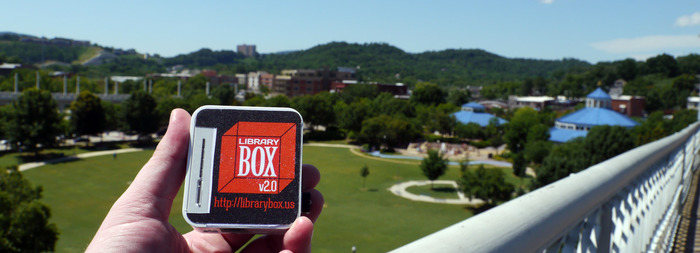
LibraryBox for Disasters (aka a Medical eBook GO Bag)

Recently, I was brainstorming about uses for my LibraryBox. If you aren’t familiar, LibraryBox is a concept started by Jason Griffey of the University of Tennessee at Chattanooga. The LibraryBox is a portable file sharing server built on a router the size of two packs of cards. The device is powered via USB cable and can be run off of a laptop, tablet, car charger, rechargeable battery pack like you’d have for your cell phone, even a solar charger is a possibility. The files are stored on a flash drive and the LibraryBox shares them out thru an internal wifi to devices via the device’s browser. Apple, Android, Windows, Phone, Tablet, Laptop; it is entirely platform independent.


I've heard Jason present on the LibraryBox and read some posts on it, but I didn't have a use envisioned. At Computers in Libraries 2013, I discovered another use as Jason had his LibraryBox on and loaded his presentation PowerPoint on it. That meant we could all download the slides to our tablets beforehand and follow along with a screen in our hands. Imagine not having to sit on the front row just to see the slides anymore.

Being a geek, I ordered the TP-Link MR3020 router and a 16 GB Flash Drive from Amazon (http://www.amazon.com/TP-LINK-Portable-802-11n-Wireless-TL-MR3020/dp/B006DEBXD0/?tag=jasongriffey-20 ) and built my own LibraryBox. But I still didn't have a practical use envisioned. I thought I might load all of my family pictures on a flash drive and share them at the next family gathering (Birthday party, Easter, Thanksgiving, Christmas, etc.).

In all the Social Media traffic from the ALA Annual Conference, I discovered Jason had started a Kickstarter project to bring LibraryBox to version 2.0.


Passing the Kickstarter information on to the ALA Think Tank group on Facebook (https://www.facebook.com/groups/ALAthinkTANK/ ) got me started brainstorming on other uses for the LibraryBox. If I say so myself, and I do, I think I found a great use.

When I was in the Air Force, we were usually subject to “recall” for deployment to any hot spot on the planet. For rapid movement, we all kept a GO Bag in our closet. Three sets of BDUs, 5 T-shirts, 5 briefs, 10 pairs of socks, 30 days of toiletries, a spare pair of glasses, etcetera; all of the things you’d need in the middle of nowhere without a Wal*mart around the corner. The contents would change depending on the season and area of interest covered by the Air Force Base I was stationed at. I obviously didn't need to carry a sweater to Saudi Arabia, but I would need it (and more) if we had to deploy to a mountainous area in winter. As an avid reader I always kept a stack of paperbacks to be read and I’d throw a pile in the top of my GO Bag.

That got me thinking that one place people need books is when they've rapid deployed to a disaster area. Especially true of medical personnel who may be forced to perform procedures they wouldn’t usually perform at home. Think about the doctors responding to the Haiti earthquake a few years ago. No electricity, phone, internet, running water; the whole infrastructure of modern life unusable. I’m sure they’d all love to have a set of basic references they can use to refresh their memory of unusual procedures. Everybody is going to do great with the basics, but the day after the event or two days after, when they want to give the patient the best recovery. When they have the time to do fine, detail work, they may need to look at some reference works. Also they may respond to a radiation event or another type of event that no one has any practice with.

The National Library of Medicine (NLM) has a division known as Specialized Information Services (SIS). They maintain a lot of resources for disaster recovery. One of those is a gateway (http://disasterlit.nlm.nih.gov/) to freely available online resources related to disaster medicine and public health. Resources include expert guidelines, factsheets, websites, research reports, articles, and other tools aimed at the public health community. Gateway, for those unfamiliar with this usage, means the resources are all linked from this one central database. You may have heard portal or federated search as other terms for this type of database.

All of the resources are downloadable files free of any copyright restrictions.
Examples of the items you can link to from the DisasterLit database include:
  • FEMA’s Radiological Emergency Preparedness: Program Manual
  • International Red Cross’ War Surgery: Working with Limited Resources in Armed Conflict and Other Situations of Violence
  • International Red Cross’ Caring for Volunteers: A Psychosocial Support Toolkit
  • International Atomic Energy Agency’s Communication with the Public in a Nuclear or Radiological Emergency
  • American Veterinary Medical Association’s Emergency Preparedness and Response (Bet you didn’t even think about animal care, but those animals may be the only food source for some while after the disaster.)


Ideally, you’d individually check the gateway and download whatever resources you’d expect to need to your tablet or phone, but what if you didn't  Or what if you don’t want to fill your device with all of these files when you may only need half of the works available? Wouldn't it be great if someone was detailed to download all of the SIS Gateway works to a flash drive? Then when you get to the Disaster Area, you can download the work you want to your device for use. What about another flash drive with a bunch of conversational language guides? You could have different Flash Drive for Flood, or Earthquake, or Volcano, or Forest Fire, or Tsunami, or whatever disaster.
 That’s my thought, a digital library of disaster resources that fit into your bag easier than a single paperback. Do you work with a team of medical personnel that might respond to an emergency? Then I could use your help.
Who should manage a program like this? Is there a resource you wouldn't want to be without? 

I’m hoping to present my idea to the NLM SIS folks, but any and all suggestions of other agencies to contact are welcome.

Thursday, May 30, 2013

Talking about Diversity

I started typing a long reply in a FaceBook group then realized it would be better placed here.

There are some topics in Librarianship that cycle around and back again. Sometimes they're initiated by a blog post someone read. Here's the article that started this discussion -- http://www.cbcdiversity.com/2013/05/searching-for-our-jeremy-lin.html#more

I've seen three different discussions today about Diversity in Librarianship. Whenever I hear someone ask "How do we get more diversity in Libraries?", my immediate thought is "Do we need more diversity in libraries?" The question assumes that as a fact to begin with, but it doesn't address it.

Maybe we need to define diversity before we start having this discussion. When you say diversity to someone of my years, I immediately go to school busing and the act of forcing children to attend a school further from their home just to even out the number of minorities in every school. That failed miserably. People want to attend schools in their neighborhood with their neighbors.
(I call it school busing, but the Wikipedia article calls it desegregation busing - http://en.wikipedia.org/wiki/Desegregation_busing )

I don't think we need that type of diversity in libraries or anywhere. I think society diversifies in its own way and in its own time.

I grew up in SE PA in a blue collar neighborhood in a blue collar city. I'm White, but grew up with a Black neighbor and Puerto Rican kid across the street that walked to school with me. I'm not "color-blind". I recognize friends and neighbors that are different races. I honestly don't care. I wasn't brought up to dwell on those differences. I played with all of those kids. The was a kid with Down's Syndrome around the corner. He had limitations, but he'd play some games, some times. Why not?

I still remember an event in High School that was identified by the local newspaper as a "Race Riot". In reality, it was a drug deal gone bad. It just happened the buyer was black and the dealer was white. When the fight broke out, it was all black guys on one side against all white guys on the other. But race had nothing to do with it.

At the end of senior year, there was an award assembly. There was actually a scholarship for the best academically performing Black. The kid that everyone expected to win stood up and some one else's name was read. We all wondered WTF? Matt is as White as they come. No he wasn't. He was interracial and we didn't know the kinky brown hair, tall height, and full lips were from his Black mother. He didn't scale as Black to us.

I had Black roommates in college, but I didn't socialize with them too much. I did socialize with a co-worker that lived a few doors down. He was Black, I'm not. Do you think folks were looking at me driving him to work and wondering what was going on? I doubt it even registered. That was the area we lived in.

 I joined the Navy Reserve while in college and was surprised there were no minorities in my unit. After graduation, I entered active duty in the Air Force. My first duty station was Ft. Hood TX. The Army doesn't have weather forecasters, the Air Force does that at all Army bases with aviation assets. I noticed that the Army was primarily Black and Hispanic and the Air Force was mostly White. But we did have one Black & two Hispanic in a 20 person unit. I think I was seeing self-selection in progress. Army soldiers were mostly urban kids, while Air Force attracted the farmers and rural kids. No one is telling people what service to join. They join because of their family and/or friends. The coastal kids join the Navy. The crazy ones join the Marines.

I still remember the mandatory Sensitivity Training session I had at my first Air Force station. They passed around index cards and we all had to say the first thing that came to mind when we flipped over the cards. My card said "Nigger Lover." My response: How old are these cards?
Trainer: That is a current set. What makes you think that is old?
Me: No one says that anymore??? That's from the 60's.
Trainer: Anyone have a different view?
Some Other Guy: Sure. If you were hanging out on a Saturday night in my hometown you might hear that if a mixed couple showed up.
Me: What??? Who would even notice? Why would you care unless you were jealous that she was with him?
Trainer: Next...

This was >25 years ago, but I remember something else from that session. Someone said something about Indians going off the Reservation. The Trainer noticed a bunch of puzzled looks so he asked for some views from the rest of the room. Plenty of us were WTF??? Wasn't Indians and reservations something out of the 1880's? Those of us East of the Mississippi had no idea there were still reservations out West.

(I was later stationed in Oklahoma City, so I know that Native Americans are a visible minority in the Western US. They are totally invisible in the East.)

My history tells me society is diversified. With my house at the 6 o'clock position on the dial, 12 is Hispanic, 2 is Hispanic, 4 is a rental & I haven't seen the new tenants yet, 8 is Black, & 10 is White.

With all of that history, 50+ years of one man's life, I don't see a problem so I'm not concerned about finding a solution. So I've come full-circle, Why do we need to do anything to Diversify? Isn't society doing that on their own?


Tuesday, May 21, 2013

Our Oklahoma City Home

Friends have asked about our Oklahoma City Home. The A marker is the house we rented while stationed at Tinker. The Red S is the Plaza Towers Elementary School.

Even more amazing to me. At this zoom, the path of the 1999 F5 Tornado shows as a tan line. The houses have been rebuilt, but the earth was so churned up that it still shows. I've circled the area in red to help you out, but the map is otherwise unmodified from Google Maps.


Friday, May 10, 2013

My Friends in their little electronic boxes


Friends,

I mean that salutation literally. You, dear readers, are the only friends I have and that concerns me.

Let me start the story in the beginning. Like most folks my age, I grew up playing outside with the neighborhood kids. Everyone within a block and within 2 years +/- my age were my friends. This continued thru my school years with only the range increasing to larger than a block and/or to being centered on specific places. I had school friends that I didn't see in the summer; Synagogue friends that I only saw on the weekend; Pool friends from the summer; etcetera.

ERSA Swim Team 1976 
(J is on back row, 1st male from the left.)

I went to college 3 hours from home and didn't go home very often, so the process started over in College. Still it followed the same pattern, friends were in the same class(es), or lived close, or worked with me, or were friends of other friends.

The same pattern reestablished itself when I was married and in the Air Force. Because life was a little more temporary, i.e. we moved more often, there might not have been as many friends as I’d had at some times in my life, but I always had someone I could invite to a Surprise Birthday party for my wife, or a backyard barbecue or to watch the big game, or whatever event called for a gathering.

Time stands still for no man. I eventually ended up stationed in Oklahoma City and divorced from my first wife. I made friends with people in the unit and I frequented a Bar / Dance Club that featured Country Dance Lessons two nights a week. The lessons were taught by a Country Dance Club and they’d match up singles or get club members to fill-in. I met the club members and dated some of the single ladies I met thru the lessons until I met my current wife. We became active members of the Club and had backyard barbecues, bridal showers, weddings, and weekends away at dance competitions. All of those activities I’d already associated with being friends. I had lots of friends and our wedding ceremony featured a fairly even grouping of co-workers, family, and dance club friends.


Soon after the wedding we transferred to Ramstein Germany and the process started all over again. We didn't join any organizations, but we had neighbor friends and coworker friends. Everything seemed normal to me.

Then came the cascade of events that ended in my separating from the Air Force. Those details may be discussed later, but for this post I’ll just say it was a rough time in my life. I returned to the states to Florida because that was where my parents lived and I had a FL Driver’s License in my pocket. (Military members can pick and choose what state they like to call home. FL has no personal income tax, so it is very popular.)

The plan was to settle in Tampa and go back to school for my Master’s degree. I had 2 year’s rights to the commissary & medical care, so I had both a nearby base and a University to attend. The same pattern “how to make friends and influence people”* reasserted itself. We became friends with neighbors and coworkers and classmates. Still it was a bit strained. I was working 40 hours a week and attending classes for another 8? hours and had homework for another 8? hours. (? = Yes, I’m just guessing at this time.) That meant I didn't have as much time for friends and we couldn't always plan on every weekend being free.

* - Would that be a better post Title?

While we were in Tampa the Apartment management had us all move out while they renovated the buildings, we moved and neighbors moved elsewhere so we had less geographic friends. Then graduation split up the classmates and all of a sudden we had more time but less people to spend it with. Like my classmates, I was looking for a job elsewhere, so I didn't really worry about it. I’d assumed it was a temporary condition.

I got that job elsewhere and we moved to Maryland. We had more family in the area, so that was an improvement, but we knew we’d be moving into a house when we found one so we didn’t make any friends around the apartment. Also my coworkers were spread out over a much larger area. We generally all lived within a 20 mile circle centered on Work, but we covered that circle from 7 o’clock on the dial around to 3 or 4 o’clock. In some cases it could take 1.5 hour to drive from my home to a coworker’s. We did buy a house, my first (at 41 years old), and that only decreased the number of potential friends by spacing out the living areas compared to the compactness of an apartment complex. 

So after 800 words, I get to the heart of the matter currently. I don’t have any friends that I can invite to a backyard barbecue or to watch the big game. I’m not involved in any organizations like the Elks, Moose, Rotary, etcetera. My wife’s health has deteriorated so we’re not going dancing. I don’t have the free time to leave the house to cultivate a friendship. I have a herd of cats to care for. I’m the only driver in the house, so I have to do all of the grocery shopping and other trips out of the house. I’m the cook and the maid. I’m not complaining. I said ‘til death do us part and I really mean it this time. I also said in sickness and in health. I will not leave the marriage this time. I take responsibility for that decision and I stand by it. If I left, Mrs. would have to live in an assisted living facility. She couldn't take care of herself.

So you, my friends, are the only friends I have. I only see little pictures of you on my tiny electronic screens. Are you real? I’ve met some of you in-person, face to face, so I know that some of you are real, but that accounts for less than 100 of you on Twitter. (I follow close to 2000. About 1200 follow me.) When it comes to FaceBook, the number I’ve met in person is higher because it includes friends from childhood, High School, College, and more distant family.

If we define a friend as someone that can feed your cats if a death in the family calls you out of town unexpectedly, or come to your rescue if your car runs out of gas, or bail you out if arrested, I’d be lucky if I had 5 people I could call on. (I know the last two are covered by roadside assistance & bail bondsmen, but the first is a real concern.)

I don’t like this situation, but I’m at a loss as to how to fix it. Is this normal in our society today? Are there millions out there just like me? Is this a stage in everyone's life or does it relate specifically to frequent moving and not setting roots? Is it right for me to join an organization that’ll take time away from managing my household? What about Mrs? Surely she feels lonely too. I’m the only person she sees most days. We do get out of the house for shopping together at least weekly. I’d probably go stir crazy if I was that limited. At least I get to interact with coworkers at the office.

This is the longest, the most personal, and the saddest post I've written. It should be in blood red; I've poured my life onto the page. Do you have any insight? Can you help me? Answer in Comments or via email to 7shore at gmail.